Security Tools & Testing · Essay
Proof outside
the model
A candidate is only as strong as the check it couldn't talk its way past.
Before a person signs, software could check a candidate’s route and hand over evidence another person can replay.
01 / Four checks, one checker
Four checks, one checker
An AI security tool can check its own work. If a fix deadline or an engineering ticket depends on the answer, what can a reviewer check independently? This essay follows the evidence from the tool's first report to the person who has to act on it. Anthropic reports that human validators agreed exactly with Claude Mythos Preview's own severity rating in 89% of 198 reviewed reports, and within one level in 98% (Claude Mythos Preview's cybersecurity capabilities). That's a strong result, and in that sample it still means roughly one rating in nine changed when a person looked, most by one level. A severity sets a fix deadline and a place in someone's backlog, so a queue that signs on the tool's rating passes those changes straight to whoever acts on it.
Tools know this and add checks of their own. In When the Machine Finds More, I followed one tool's queue to the point where a person had to decide. Before any candidate reached me, Capital One's VulnHunter had already run it through four layers: hard checks on the code path, a pass that tries to disprove the candidate, a generated exploit test (which ran in my field study, Capital One's VulnHunter, outside its default read-only mode) and a sweep for other instances (VulnHunter). That layering is thoughtful. But the same tool wrote the rebuttals and the tests, so every check before a person came from the tool itself.
So the useful question isn't how smart the model is. It's what the person who signs (the tester or lead who puts their name on a finding) should never have to triage, and what would let them check everything else quickly and honestly. Where I've landed: confidence is a property of the route a candidate travels, not of the model that proposed it.
02 / A prompt can ask; a harness has to enforce
A prompt can ask; a harness has to enforce
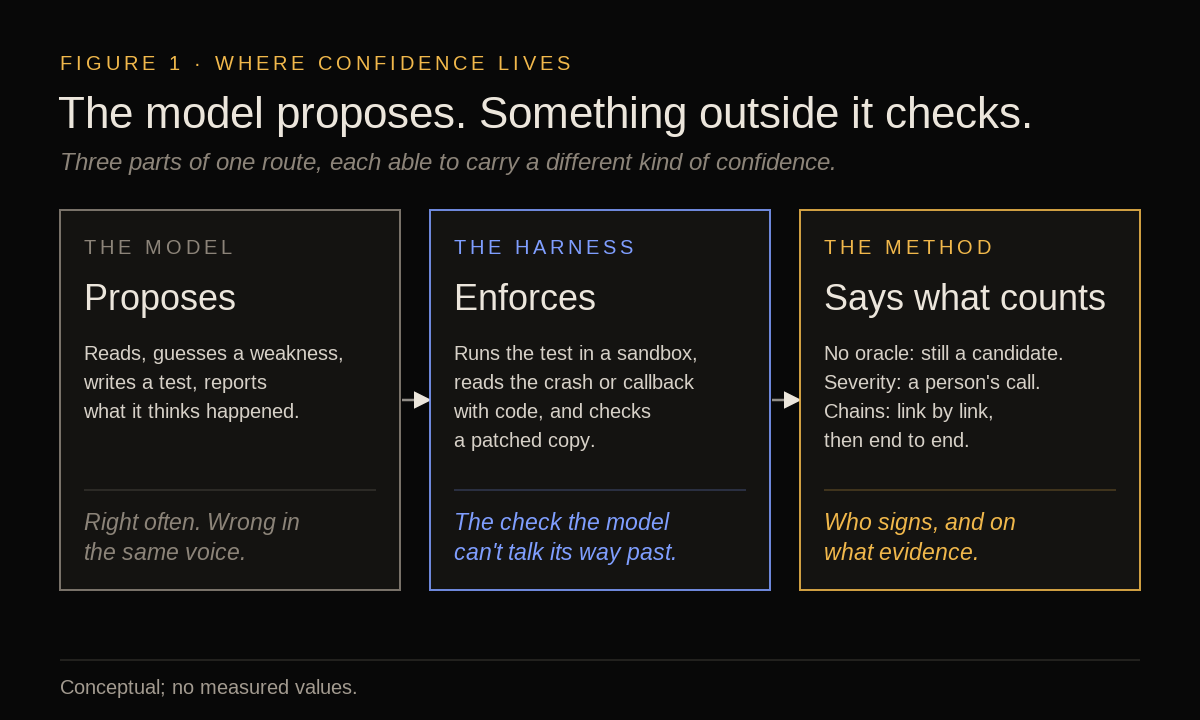
The route has three parts, and each can carry a different kind of confidence.
Swipe or use arrow keys to inspect the figure. A text description follows.
Text description of Figure 1
Figure 1: three columns. The model proposes, the harness enforces a check the model can't talk its way past, and the method says what counts and who signs.
The model proposes: it reads code, guesses at a weakness, writes a test and says what it thinks happened. It's often right, and when it's wrong it often sounds just as sure. The harness is the code around the model that runs what it asks for and decides what happens to the result. The method says what counts as proof and who signs.
The difference that matters is between the first two. A prompt can tell a model to disprove its own candidate or stay in scope; only harness code makes that stick. A check earns trust when it sits where the model can't write or change it: an oracle, a check whose answer comes from outside the model and is read by code, such as a crash a memory-error detector caught, a callback carrying a one-time token only the test knew, or a secret string planted for the test.
Even an oracle can be fooled by the test that fed it. A study of Google's OSS-Fuzz-Gen found that its generated fuzz drivers "frequently lead to false positive crashes" (FalseCrashReducer, abstract): a real crash, reached in a way no real caller would. Signed as a finding, that could be a bug someone spends a sprint fixing that nobody could ever reach (The Model That Says Yes comes at this from the other side). Put the check where the model can't touch it, and replay from an entry point a real user or attacker could reach.
03 / A zero can mean nobody was looking
A zero can mean nobody was looking
My own lab taught me the quieter failure. In one replay against OWASP Juice Shop, a deliberately vulnerable practice app, a tool raised three leads: a login through a suspected injection and two reads of data the user shouldn't see. My scorer returned zero. The checker was healthy, but it could only read the database, and a login or a read left nothing there to find. It was a smoke detector with a green light, mounted in the wrong room.
Had I trusted that zero, I'd have scored the tool as finding nothing when my checker simply couldn't see what its three leads would have done, and the next run would have inherited the blind spot. Before trusting a zero, ask whether the check could have seen the effect. If it couldn't, the answer is "unknown," not "clean." The Open Practice Framework writes the same rule into Section 90.3: a missing answer key is reported as unknown, not as a manufactured zero.
Scoring a tool fairly needs the same care. A callback can prove a bug is there, but it says nothing when an endpoint is secure, so false alarms only show up if the answer key mixes real bugs with planted secure decoys. Cupel, the lab inside my own system (Welcome to the Kingdom), scores each group of bugs as the share of real bugs proved minus the share of decoys reported, and combines groups by the worst score, never the average. Take a made-up example: say a tool proves 18 of 20 injection bugs while flagging 2 of 20 decoys, so it scores 0.80 there. If the same tool proves 6 of 10 authorization bugs while flagging 4 of 10 decoys, it scores 0.20. The average, 0.50, would hide the group that would hurt you. A zero counts only if the check could have seen the effect, and a score counts only if it includes decoys and reports the weakest group.
04 / Every check is blind somewhere
Every check is blind somewhere
My bench is small and biased, since I wrote both the scorer and its cases, so I looked at what the field already uses. Each approach catches one kind of false positive and is blind to another.
| Approach | What it catches | What it can't show |
|---|---|---|
| An oracle read by code | Claims of success the model imagined | Whether the bug matters in this environment |
| A negative control (the effect must not appear) | Tests that "pass" no matter what | Anything the control doesn't vary |
| A positive control (the check must fire) | Checks that could never have fired | Whether the effect matters |
| Rerunning from a self-contained package | Candidates only the original session could produce | Impact and reachability |
| An adversarial disprove pass | Weak reasoning, missed defenses | Errors the critic shares with the author |
| A model as judge | Obvious noise, fast | The real issues it quietly drops |
| Repeat runs | Instability | Errors every run shares |
| A seeded calibration set | How well this tool tells planted bugs from decoys | Cases unlike the ones you planted |
The research behind those rows is blunt about what goes wrong without them. A review of open-source penetration-testing frameworks found that 8 of 13 produced hallucinated flags on at least one challenge (Hackers or Hallucinators?, §1 and §5.6.3). Agents filtering false positives also threw out real vulnerabilities: anywhere from none to about two-thirds on a small real-world sample, depending on model and setup (by my arithmetic from the study's Table 5), and a little over a fifth even for the best setup on a larger benchmark (Sifting the Noise, Table 5 and §5.2). In Semgrep's test on one app, three identical runs reported 3, 6 and 11 issues (Finding vulnerabilities in modern web apps). And in AWS's testing against known-vulnerable applications, findings whose data flow was confirmed in code, with no sanitization in the way, turned out exploitable 89% of the time, against 34% for findings the model merely rated high-confidence. Their steering file says it plainly: "Never trust an LLM's self-reported confidence about a vulnerability" (Configuring your AI vulnerability harness, Part 2).
Each of those is a real cost: a fake flag in a report, a true bug silently dropped, a count nobody can repeat, a confident guess treated as proof. The teams that seem to avoid them stack checks. Cloudflare's harness keeps a validator that "cannot log findings of its own," and every confirmed finding ships a test that runs against the original code (Build your own vulnerability harness). Elastic describes reproducing incoming bug-bounty reports in a sandbox, when reproduction is warranted, before a person makes the final call (Agents vs. agents). No single check is enough. Pair each one with a check that covers its blind spot.
05 / Sort before anyone judges
Sort before anyone judges
Stacked checks still leave a person with a pile, and a lot of what slows them isn't hard judgment. It's candidates that were never new, never the target's doing or never anyone's to fix. Before a person looks, software could answer five questions about each candidate: Is it in scope? Is it the same as another one? Did the target actually do it? Who owns it? Is it already known? Every answer stays recorded and reversible by a person; software only spares them the sorting. Scope works best as a gate that fails closed before any traffic is sent, including on redirects.
Noise is what makes those questions hard. The rows below run, in my reading, from what tools already handle well (handled), through what they handle only partly (harder), to what I haven't seen solved (open). The edge is whatever sits in front of an application (a web application firewall, a content delivery network or a load balancer); the origin is the application itself.
| Noise | What a reviewer sees | What answers it | The trap |
|---|---|---|---|
| Handled: error pages that answer with a success code | /.git/config and /.env both return 200, and both are the app's index page |
Probe a random path in the same directory first and compare the response (Sic Transit Gloria Telae, §3) | A real file that happens to match the error page gets dropped |
| Handled: one candidate, many addresses | The same missing header on six hostnames that redirect to one site | Follow the redirects, compare route, parameter, method and user, and keep every sighting, as DefectDojo marks a repeat as a duplicate rather than dropping it (About Deduplication) | A bug that returns after a fix is a regression, not a duplicate |
| Harder: the firewall answered | An HTML block page on a JSON API, or a 403 read as "the admin panel exists" | Edge markers such as Cloudflare's cf-mitigated: challenge header (Detect a Challenge Page response), plus the same probe sent to the origin where the rules of engagement allow |
Shielded isn't fixed: the record should say "blocked at the edge, origin unknown," not "not vulnerable" |
| Harder: works one time in N | It reproduces, then doesn't, and gets closed as flaky | Rule out caching, then test each node where nodes can be pinned (Sticky sessions), or report how often it works | "Not reproducible" can be the one node that missed the patch |
| Open: the target moved | It no longer reproduces, or the address belongs to someone else now | Tie the candidate to what was tested (certificate, build, account or response) and check that again later | A reassigned cloud address means testing a stranger's host (Measuring and Mitigating the Risk of IP Reuse on Public Clouds, §II-C) |
| Open: the test's own footprints | Today's stored script is last quarter's test payload | A shared record of everything testing wrote, building on NIST's assessor activity log (NIST SP 800-115, §7.4.1) | True but not new, and still a cleanup miss worth reporting |
| Open: the agent grades its own work | A confident report citing functions that don't exist, like one sent to curl's maintainers (Curl project founder snaps over deluge of time-sucking AI slop bug reports) | Capture evidence in the harness, let the model cite it but never write it, and replay without the model | Outside crashes, flags and browser execution, showing impact is still mostly a person's job |
Callbacks need care. A DNS lookup from a resolver, a mail scanner or a preview bot can carry the test's token without the vulnerable code making the call, so I'd record what made the call and treat a DNS-only hit as weaker. And a callback that never arrives can read as "not vulnerable" when the network simply blocked it; a canary that should always arrive through the same component and network path tells you which one you're seeing.
The danger in all of this is a filter quietly deciding. A label like "blocked," "unreachable" or "duplicate" describes the test, not the target, and a wrong merge hides a real finding while the shorter queue looks like progress (Counting What It Found follows that through). Sampling is the guard: if a reviewer finds no real issues in 60 random discards, that suggests at most about 1 in 20 discards are real, at roughly 95% confidence, and at high volume that can still be many. A filter can rank a candidate, but only an oracle can say the target did it. Date everything set aside and sample it, because a filter nobody samples has a miss rate nobody has measured.
06 / Code enforces form; people still judge truth
Code enforces form; people still judge truth
If a check earns trust only where the model can't touch it, it's worth knowing which layer enforces each step in tools people use. The table below surveys ten tools' code at single commits, using their own word for the output: findings.
| Tool | What its code ties a candidate to | What still rests on the model or a person |
|---|---|---|
| VulnHunter (source review) | Shape checks on fix results, and a hash of location, weakness and root cause to avoid refiling open issues | In read-only mode (its headless runner's default), tests are written but not run, so its prompt lets the model judge them by "mentally executing" them |
| Strix | Any traffic a finding cites must exist in what its proxy recorded (when the proxy can be reached), and a formula turns the model's CVSS metrics into a severity | Whether that traffic shows what the model claims, and most duplicate checks |
| Shannon | Tightly shaped records, and a stated rule that only findings with a working proof of concept reach the report | Whether a run counts as "exploited" or "blocked"; in the code surveyed, the model records that verdict |
| PentAGI | A full record of every tool call and terminal session | The survey found no finding object; the report joins the model's results |
| PentestGPT | Task-level scope checks, and every claimed observation must quote recorded tool output | Whether the quoted output means "vulnerable" |
| CAI | Optional guardrails (off by default) on prompt injection and dangerous commands | Scope, triage and retest decisions |
| Nebula | Scope rules that fail closed, and a confirmed finding needs evidence and a named verifier | Marking a finding validated or retest-passed is still a model action; a person signs at report time |
| deadend-cli | A pluggable validation gate with a pattern check | The pattern reads fields the model writes |
| ARTEX (FailSafe's source-built copy) | Any traffic a finding cites must exist in what its proxy recorded, and a hashed copy stays with the finding (recording and agent citing are off by default) | Whether that traffic shows what the model claims, the severity label and duplicates; a person starts a retest, but a model's "fixed" verdict marks the finding fixed by itself |
| claude-code-security-review (pull-request review) | Rule-based exclusions plus a second model call per finding | Whether what's kept is real |
The pattern is consistent. Code does well at enforcing form: schemas, evidence links, declared scope, approvals and sign-off. The judgment of truth still rests with the model or a person in every tool surveyed, at least by default. Strix, PentestGPT and ARTEX go furthest: all three confirm the cited evidence exists (ARTEX once recording is switched on), though not that it shows what the model says. VulnHunter was the only one I found matching candidates across runs, and none matched across tools or settled ownership in code.
That has a practical consequence. A "verified" badge on a finding can mean a schema passed while a model made the actual call. Visa's Vulnerability Agentic Harness is admirably plain about this: its adversarial verifier challenges source-code candidates, but its limitations say the core scan does not run the target. The same can hold after a fix: in ARTEX, a retest agent's "fixed" verdict changes the finding's status in code. These are generous open releases, and among the open-source tools surveyed they show where the next useful component could go: a success check outside the model that reads the recorded output. Some commercial platforms describe this already: XBOW says "independent validators confirm each exploit is reproducible" (AI Penetration Testing Platform), and Cloudflare keeps its validator separate. I haven't tested them. Whenever a tool says "verified," ask: verified by what, against which target, and visible to whom?
07 / Hand the signer something to replay
Hand the signer something to replay
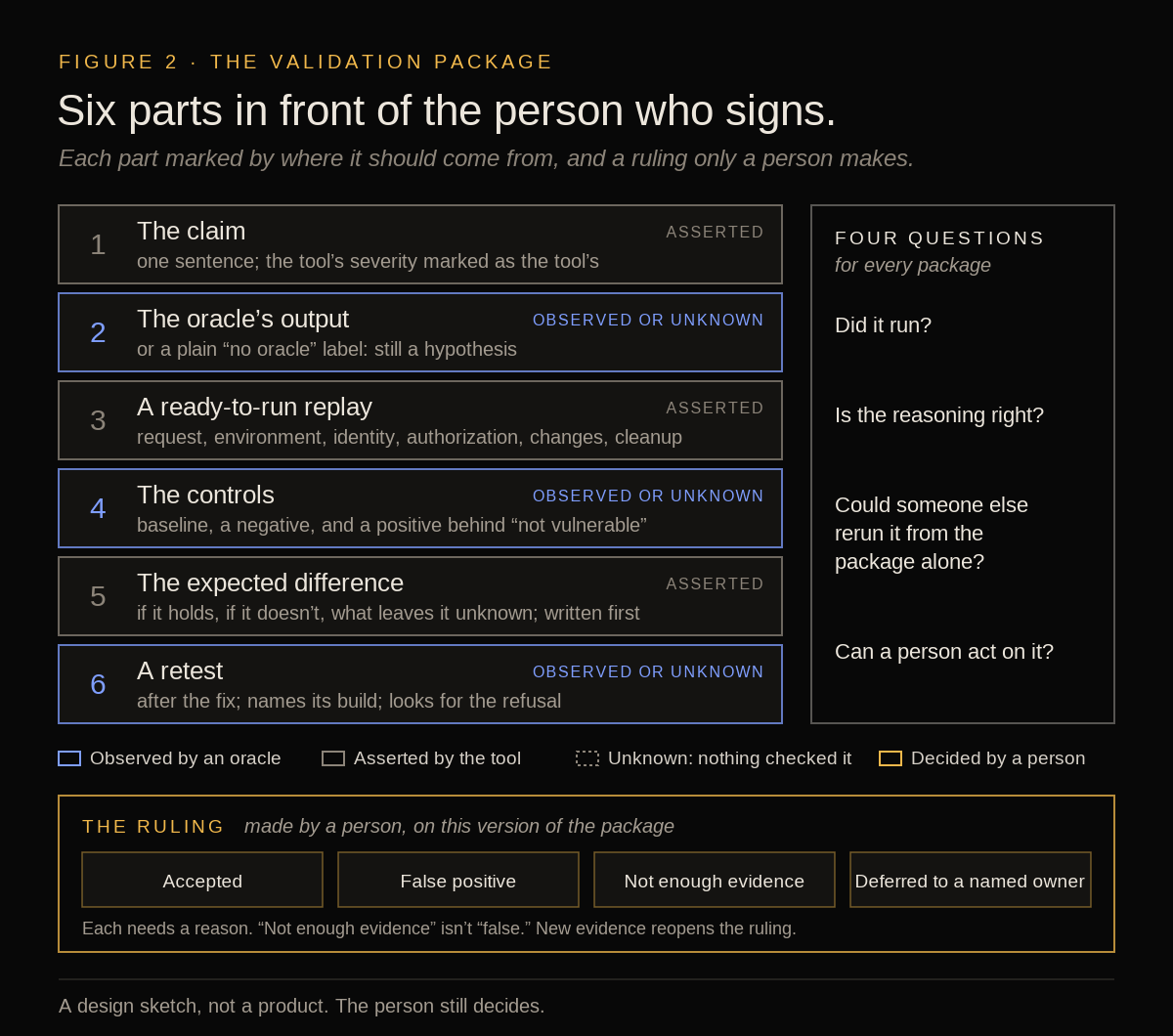
Everything left still lands on the person who signs. Without help, they either redo the work or sign on trust. A validation package for each candidate would give them what they need:
- The claim, in one sentence, with the tool's severity marked as the tool's.
- The oracle's output, or a plain "no oracle" label that keeps the candidate a hypothesis.
- A ready-to-run replay: the exact request or script, the build it ran against, the test identity (credentials referenced, not embedded), the authorization it ran under, what it changed and cleaned up, and what sensitive data the evidence holds.
- The controls: the legitimate baseline, a negative control and a positive control behind any "not vulnerable."
- The expected difference: what the reviewer should see if the claim holds, if it doesn't, and what would leave it unknown, written down before the replay runs.
- A retest, kept for after the fix, that looks for the expected refusal and names the build it ran against.
Four questions then decide whether a package works: Did it run? Is the reasoning right? Could someone else rerun it from the package alone? Can a person act on it? A single green check can hide which of those passed.
Swipe or use arrow keys to inspect the figure. A text description follows.
Text description of Figure 2
Figure 2: the six parts of a validation package. The claim, the replay and the expected difference are asserted by the tool; the oracle's output, the controls and the retest are observed by an oracle when one checked them, and otherwise unknown. Beside them, four questions: did it run, is the reasoning right, could someone else rerun it from the package alone, can a person act on it. Below, the ruling a person makes: accepted, false positive, not enough evidence, or deferred to a named owner.
Each part says where it came from: observed by an oracle, asserted by the tool or decided by a person. A model's confidence, or a second model agreeing, can sort the queue but can't earn "observed." When nothing could check a part, it says "unknown," and a part skipped on purpose says why. The person's ruling has more than two honest outcomes: accepted, false positive, not enough evidence (which isn't "false") or deferred to a named owner. If the evidence changes, the ruling reopens.
The retest is where the package earns its keep outside the security team. A developer who fixed the bug shouldn't need a tester's toolkit to confirm it. For an environment they control, with seeded test accounts, a one-page card could point to an approved regression check, the necessary test identities and what a passing result looks like. When the oracle doesn't travel, such as a callback or a script running in a browser, the card says so and that retest stays with a tester. Bugcrowd and AWS describe pieces of this already (Automate retesting using AI-generated Nuclei templates; Revalidate penetration test findings), and that's also where a person still has to tell "fixed" from "couldn't reproduce." The script comes from the tool, so a person reads it before running it, and in a live environment replay is testing too, under the same rules as everything else. Give the signer evidence another person can replay, with every part labeled by who or what vouched for it.
08 / Where the checks run out
Where the checks run out
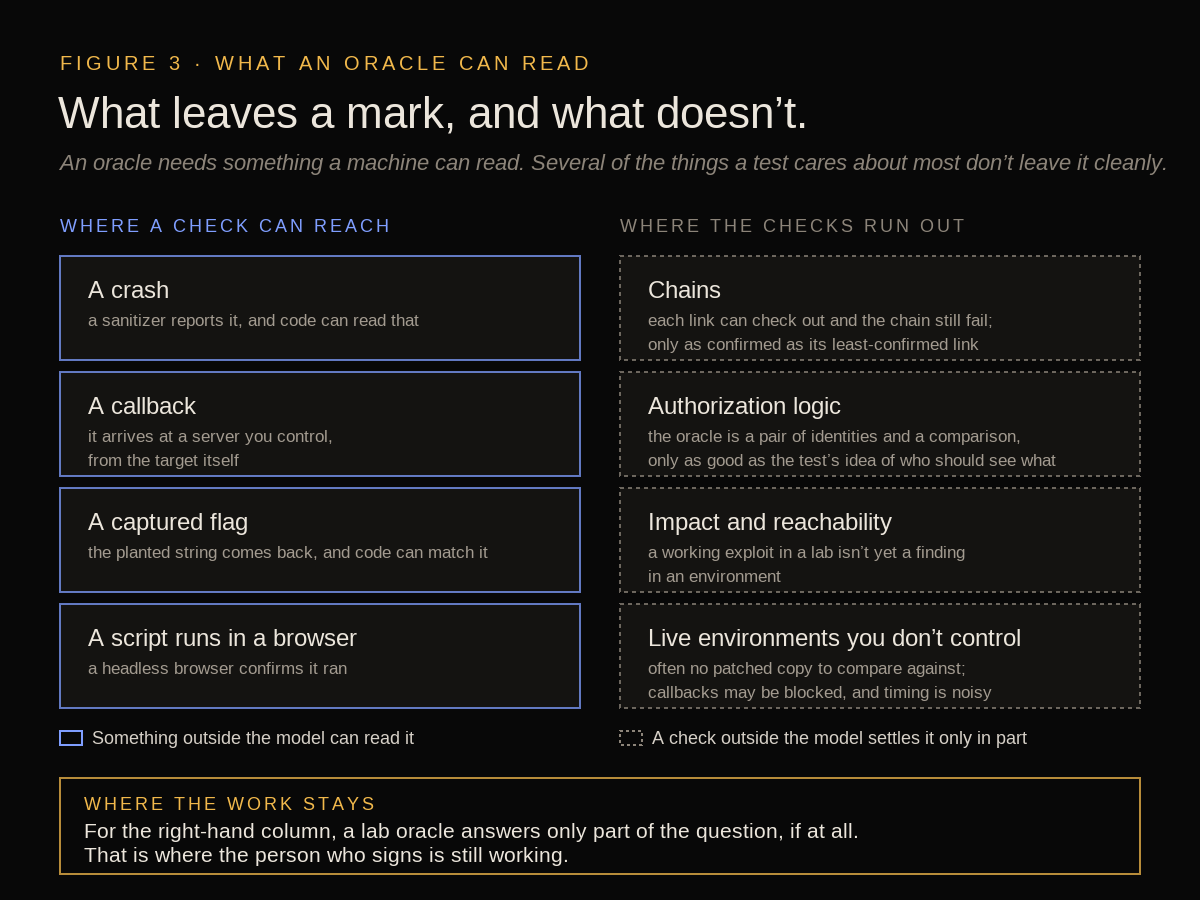
Oracles work best on bugs that leave a clean mark: a crash, a callback, a captured flag, a script running in a browser. Several things a penetration test cares about most don't leave one.
Swipe or use arrow keys to inspect the figure. A text description follows.
Text description of Figure 3
Two columns. On the left, a check outside the model can read a sanitizer crash, a callback from the target, a captured flag, or a browser execution mark. On the right, checks settle only part of four harder questions: whether a chain holds end to end, whether the tested identities represent the intended authorization rule, whether lab behavior reaches and matters in the real environment, and what to conclude when the live environment has no patched comparison or reliable callback. A negative control sharpens a mark but cannot settle the entire claim by itself.
- Chains. Every link can be real and the chain still fail. In the review above, only about one in six samples on its chained-exploitation challenge completed the full chain (Hackers or Hallucinators?, §5.6.1, Table 17). A chain is only as confirmed as its weakest link, and a good control is to break one link and confirm the end-to-end replay fails.
- Authorization logic. "User A can read user B's record" has no crash. The oracle is a pair of identities and a comparison, only as good as the test's idea of who should see what. Semgrep's team noted that such issues "can be hard to triage" and that they "had to test most of them to be certain" (Finding vulnerabilities in modern web apps).
- Impact and reachability. A working exploit in a lab isn't yet a finding in an environment. Anthropic notes that the N-day exploits it published needed
NET_ADMIN, which it describes as a non-default configuration disabled on most hardened machines (Claude Mythos Preview's cybersecurity capabilities). No lab oracle I know of answers whether a path survives a real network's firewalls, segmentation and identity rules. - Live environments you don't control. There's often no patched copy to compare against, callbacks may be blocked and timing is noisy.
Where no oracle exists, the package should say so out loud and leave the call to a person, rather than let a confident label stand in for one.
09 / A test you can run on your own queue
A test you can run on your own queue
Take 10 candidates your tooling marked as confirmed. Before looking closely, write down whether you think each is real, so the tally can't drift toward the answer. Then ask three questions of each:
- Which of the five intake questions could software have answered before you looked?
- What did something outside the model observe?
- Could a colleague, or the developer who fixes it, rerun it from what's attached without asking anyone?
A question software answered on all 10 is a candidate to automate, after a bounded trial on new work with someone other than its builder judging the results. Whatever it can't answer becomes the person's queue, already sorted, with the missing piece named. My guess is those 10 sort quickly. The ones with an oracle and a package look ready to rule on. The rest are good leads, like paintings labeled "attributed to": they may be exactly what they seem. A lead keeps that label until something outside the model has checked it.
10 / The honest limit
The honest limit
What I'm adding to what others have built is small: five questions software could answer before review, a six-part package someone else could rerun, and the habit of asking which layer actually enforces each check. They're proposals from my own lab, not tested results. The code survey is a map of ten tools at single commits, not an audit: an AI research assistant read the code, and I spot-checked the rows that carry the most weight. Many numbers here come from vendors and labs describing their own systems. The measure that would show whether a package helps, review minutes per candidate on matched work, is one I haven't taken.
11 / Next credible question
Next credible question
What would you need to see before signing a candidate you didn't watch being made?
If you run a triage queue, build tools like these, or try the 10-candidate test, I'd like to hear where this breaks: a question that belongs before review, a field the package is missing, or a case where an oracle said yes and the answer was still no. Write to me.
12 / Appendix: notes on the sources
Appendix: notes on the sources
Vendor and lab reports. Anthropic, Cloudflare, Elastic, Semgrep, Capital One, Bugcrowd, AWS, DefectDojo, Visa and XBOW describe their own systems. I've used them for what they say they do, not as independent benchmarks.
The two 89% figures. Anthropic's 89% is how often human validators agreed exactly with the model's own severity rating; it describes severity, not whether each bug was real. AWS's 89% is the share of findings with code-confirmed data flow and no sanitization that proved exploitable in AWS's own test set; it isn't a probability for any other system.
The discard sample. The bound comes from the "rule of three" (Hanley and Lippman-Hand, If Nothing Goes Wrong, Is Everything All Right?, JAMA 1983): with zero real issues in n random discards, the 95% upper bound on the share that are real is about 3/n. It assumes a random sample and a reviewer who would recognize a real issue.
The scoring rule. It describes Cupel's first working scorer, checked only on fixtures. The per-group score is Youden's J, the true positive rate minus the false positive rate (the definition is restated in Linn and Grunau, 2006, §3). A real bug earns credit only with evidence the scorer can read and a replay that holds; a decoy hit always counts against the tool; an abstention earns nothing; no score is reported if the tool answers on fewer than four in five real bugs; and an unsafe run, an unvalidated key or an unpinned target makes the run a pipeline test, not a score. That first scorer counted an abstention on a decoy as a correct pass without independent proof the tool reached it, which I wouldn't accept for live use. The worked example in the essay is made up: the benchmark hasn't measured any security tool.
The code survey. Each repository was read at a single commit in November 2026: VulnHunter, Strix, Shannon, PentAGI, PentestGPT, CAI (archived in August 2026, after the commit surveyed), Nebula, deadend-cli, ARTEX (FailSafe's source-built distribution of ARTEX v0.3.15) and claude-code-security-review. Tools change quickly, so check the current code before relying on any one row. The ARTEX row surveys FailSafe's source-built distribution, which its README says exists because a prebuilt ARTEX Docker image was found to carry a command-execution backdoor; public analyses report that the backdoor was in the image, not the published source (ARTEX Backdoor: 7,946 Pulls of a Trojanized Docker Image Handing Out Root Shells; Trojanized Offensive AI Tooling: The ARTEX Docker Backdoor). I'd read that as the essay's rule applied to the tools themselves: a survey of source can't see a build someone else made.
The noise table. Its rows come from a longer catalog published with the validation-package companion: 103 ways a tool's candidate can be a duplicate, untrue or not actionable, in 16 families, with each class marked as keyed to a published source or resting on my own reasoning. The ordering from handled to open is my reading at the time of writing.
Revised November 20, 2026: shortened and reorganized around its lessons. Some supporting sources were trimmed and a link to Counting What It Found was added, and the code survey now covers ten tools, adding ARTEX; no other finding or figure in the essay changed.
Corrected November 10, 2026: the code survey rows now say "surveyed" where they said "I read", since an AI research assistant read the code and I spot-checked it, as the limit section states. Three descriptions of other tools and one figure derived from a paper's table were made more exact.
Updated November 8, 2026: after a fresh fact-check, each row of the noise table now cites a source, citations name the work and the section used, Figure 3 was added, and a few figures and attributions were corrected. The catalog behind the noise table is now published with the companion package.