The Dunvaric Kingdom · 02
Where the names
come from
A lost world, an empire I didn't want, and four lessons the fiction taught the system.
In short The Kingdom's names came from stories I wrote with AI. The fiction ended up teaching the system four things.
Published Updated 7 min read
01 / Lesson one
Keep the original
The first story wasn't about my AI system at all. In early July I was exploring a venture. To give it a soul, I pasted a world into a browser chat with Google's AI. It had a foundry theme, a coin struck once for each member, a watch that kept your obligations, and a set of houses from city to wilderness.
The chat turned it into planning documents. The documents kept the business and dropped the world. Nobody saved the original paste, not the assistant and not me, and two weeks later it was gone.
So I asked an AI to rebuild the world from the fragments that survived, and to mark every element as either witnessed in the old documents or reconstructed as new invention. The result was close, and I knew exactly which parts were memory and which were guesswork. The lesson got written down in words the Kingdom still uses: distillation is not retention. A summary is not the thing. If you work in AI chats, keep the original, and when you have to rebuild, label what you made up.
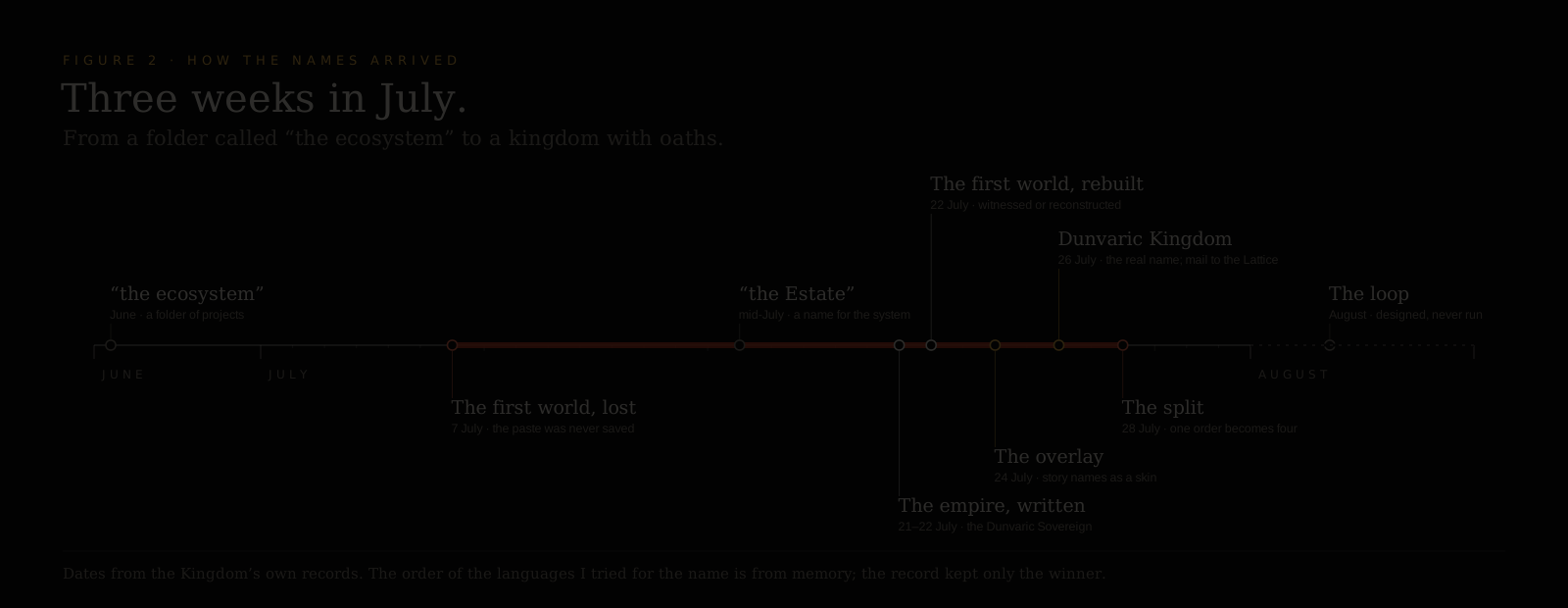
Text description of Figure 2
A timeline from June to August 2026 with July drawn at a larger scale. June: the ecosystem. 7 July: the first world is lost. Mid-July: the Estate. 21 to 22 July: the empire is written and the first world is rebuilt. 24 July: the overlay. 26 July: Dunvaric Kingdom becomes the real name. 28 July: the split. August: the loop is designed and never run.
02 / Lesson two
Write your system as fiction
Meanwhile the system itself needed a name. In June it was just "the ecosystem." By mid-July it was "the Estate." I went looking for something with weight, through Latin, then Germanic, then Old English and Norse, and settled on a Celtic root joined to an oath: Dunvaric, from dún, a stronghold, and vár, a sworn watchfulness. It's a coined word, not a claim about real etymology.
The name came from a story I wrote over a night in late July: the Dunvaric Sovereign. The ideas and the shape were mine; the AI did a lot of the prose. It was magnificent and a little terrifying. A ruler trained from birth to read the telemetry of the whole realm. An invisible legal engine, the Lex-Lattice, that re-routed materials and issued plans on its own, so nothing would wait for a human. A furnace that remelted every broken blade. A fortress that kept a ledger of everything ever made. And an order whose job was to attack the realm's own defenses, live, on its own.
When I read it back, I recognized it. It was the thing I'd been trying to build: one central intelligence that would see every project and move the work without waiting for me. In costume, the problem was obvious. A system that acts faster than anyone can contest it is frightening, however efficient it is. The Lex-Lattice had no place for anyone to say "wait."
That's the most useful thing I can pass on from this whole series. A diagram shows you what a system does. A story shows you what it's like to live under it. If you're designing something with agents, write it as a world and read it as a citizen. So the real Kingdom went the other way: Foundry became a steward that makes and keeps shared tools, not a king, and a person decides what's published, spent, deleted or begun.
03 / Lesson three
Split the roles the story fused
Some of the empire was a warning. Some of it was exactly right in the wrong costume.
| In the story | In the system |
|---|---|
| A furnace that remelts every broken blade | Each build carries its lessons into the next |
| A seal etched into every made thing | Every released tool has a version and a fingerprint you can check |
| A ledger of everything ever made | The Kingdom's memory |
| A legal engine that never waits for a human | Rejected: a person decides |
| One order that attacks, audits and judges | Four separate orders |
| A watch only someone else can wind | The maker never grades their own work |
The fifth row mattered most. The order that attacked the defenses also reported on them and, in practice, judged them. Seeing it in costume made me see that those are different jobs. On the 28th of July I retired it and replaced it with four: one sworn to find weaknesses, one to watch, one to defend, and one to read the oaths and the evidence. (The offensive house got its name along the same road, from a phalanx to House Thalis.) It was the first time a story changed the system's design rather than its vocabulary.
The pairs that came out of the split are the rules I actually remember. Two of the new roles were named for the guild: the Traveler, who keeps the record of what happened, and the Witness, who judges it. The Traveler remembers what happened; the Witness decides what the evidence can bear; neither is permitted to become the other. They read like fiction and work like policy. If one agent builds and the same agent decides it's done, you don't have a check. You have a mirror.
04 / Lesson four
Put names on as a skin
Beautiful names are dangerous. Once a system has them, it's tempting to rename everything, and renaming files, folders and code mid-flight breaks things. When the Estate became the Kingdom on the 24th of July, I half expected a rename. Foundry didn't want one. The story names went on as an overlay, a skin over the working names that never touches a path. I wanted the tooling layer called LatticeWorks, and on the skin it is. Underneath it's still MetalWorks, and nothing broke.
There's a second lesson hiding in that decision. A rename is cheap on day one and more expensive every day after. Every new house, tool and message that learns a name is one more thing a rename has to touch, and in a system that keeps growing and connecting, that cost only climbs. The skin bought me time. It didn't make the debt go away. That lesson is shaping the next phase of the Kingdom, and I'll come back to it.
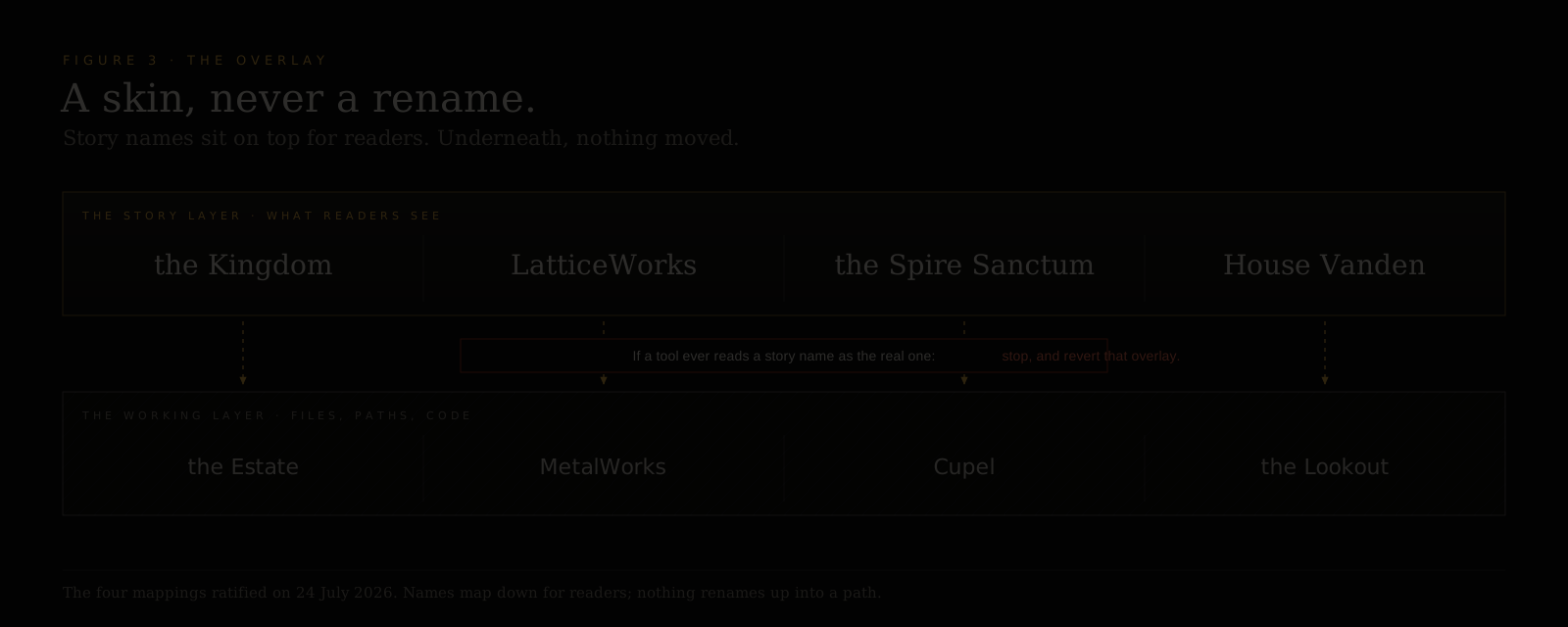
Text description of Figure 3
Two stacked layers. The story layer shows the Kingdom, LatticeWorks, the Spire Sanctum and House Vanden. Beneath it, the working layer shows the Estate, MetalWorks, Cupel and the Lookout. Each story name points down to one working name. Between them sits a rule: if a tool ever reads a story name as the real one, stop and revert that overlay.
A note on the fourth pair in Figure 3, the Lookout. The Lookout was the Kingdom's scout: curated outside research, read-only by rule. A Lookout finding could inform an idea but never trigger an action or overturn the lab's verdict. In the story it's House Vanden, the house that rides beyond the walls and reports back. It stood down in late July, along with everything else that read untrusted outside content, and came back as the last step of a rebuilt intake, where only a person can raise the trust of what arrived. That rebuild is its own story.
The same instinct shaped one more name. The connective layer between the houses (mail first, then the shared skills, plugins and repositories) moved out of Foundry's folder into neutral ground called the Valence Lattice. A steward that also owns the shared shelf isn't really neutral, and I was bringing Claude and ChatGPT into the same system, so the shared parts had to work whichever one held a folder. The word itself is older than the Kingdom: it's left over from a search engine I once tried and failed to build, where related things would attract each other like particles. It finally found the right job.
The general rule: let the story name things for people, and never let it name things for machines. A story name never becomes a file path, and a story rule never becomes an authority.
05 / Not yet built
The loop I never wired
The plan was always a loop. The Kingdom would hand the stories real problems, and the stories would hand back new questions: what would a counterfeit look like here, what happens when the Witness is wrong, who audits the auditors. In August I designed the first experiment for it. It never ran. So far the traffic has gone one way, from story into system. That's a place where the Kingdom is more intention than mechanism, and I'm fine saying so.
Here's what one turn of it might have looked like.
A side story, never run. In the Kept Hours, a smith brings the Witness a blade and asks for the seal. The Witness tests it, finds it true, and reaches for the stamp. Then it stops. It remembers that it chose the test. It wrote the bar the blade just cleared. "I can tell you this blade passed my test," it says. "I can't tell you my test was the right one." The smith asks who could. Nobody in the guild has an answer, so the question goes over the wall to the Kingdom, where it becomes a ticket: who tests the test?
That's the trade I wanted: the story asks a question the system hadn't thought to ask, and the system has to answer with something real. It's still a good idea. It's still unbuilt.
The likeliest first test is one of the unwritten stories: a small sworn crew sent beyond the edge of the map, carrying a kingdom shrunk to fit in a kit. That one gets its own essay.
06 / Why bother
Why bother
A spec asks what a thing does. A story asks what a thing is: who it serves, what it would never do, what happens under strain. The world I lost taught me to keep originals. The empire showed me the system I didn't want. The split gave me rules I remember. The overlay let me keep the names without paying for them in broken paths.
If you're building something large with agents and the diagrams have stopped helping, write the world it lives in. Keep a copy of the first draft.
Next on the tour: what it takes for a project to remember. Follow it on the map.